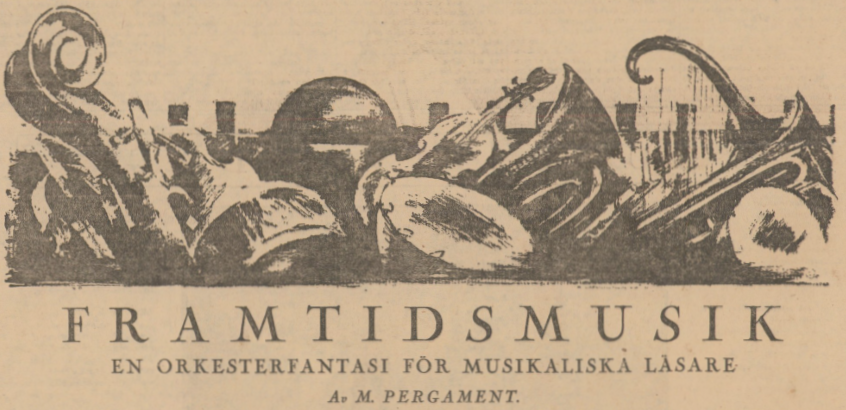
Music of the Future
An Orchestral Fantasy for Musical Readers
By M. Pergament
THE ORCHESTRA had convened a meeting. There was unrest in the air and rumours of revolt spread from group to group. The discontent was everywhere palpable, and here and there the displeasure with the fashions of the day took the form of scathing derision. The tremendous burden of work these last two decades had left its mark upon the various instruments in different ways. Some looked worn; others were obstinately gloomy. Only a few had preserved that sensuous, fiery glance. The violins had fared best. An intoxicating scent of passion hung around them. When they moved or spoke, it was as if they radiated glowing clusters of colour. The flame burned even among the clarinets, though more subdued. The English horn had a saffron-yellow complexion and wore a long reddish-brown cloak, which gave the whole appearance a curious air. He was taciturn, as always; but should he happen to have anything to say, one noticed his colour more than his words. The French horns, on the other hand, had long commanded everyone’s undivided attention and admiration. Who could, like them, produce that sonorous forte and let it slowly fade into infinite distance? “Like dying swans they sang,” yet the power of the storm-song was theirs also. They had taken a dignified place in a corner and seemed minded to await the course of proceedings. The flutes and the smaller clarinets had gathered round the oboes and chattered eagerly about questions of pitch. The cheeky piccolo had climbed upon an old, venerable double bass and told him impertinent stories of its military service. The other double basses were engaged in grave converse with their octave-kin, the cellos.
There was still clamour and disorder among those assembled; there was chatter on the right and left, and the disputes frequently grew very loud. It was clear that they were still waiting for someone before the meeting was declared open.
— What the devil are we waiting for? hissed the piccolo in the ear of the double bass.
— The trombones and the tuba, I’m afraid, said an ingratiating bassoon, who stood hidden behind the double bass and had caught the whisper. We have to elect a chairman. The gentlemen here are constantly talking over each other, and there will never be any order here unless the contrabassoon—
Here he cast a spiteful glance at the double bass and disappeared with a wheezy little old man’s laugh into the crowd of other bassoons. A cello had observed the scene and now drew nearer.
— For centuries, grumbled the angry bass, they have been in our service and eaten out of our hands, so to speak, but since the man from Bayreuth freed them, they have become insolent. Damned rabble!
The bass had struck the bassoonists’ most sensitive spot, for they had indeed existed for a long time only as reinforcement for the cellos and double basses. The jab pleased the cello, and he added:
— Yes, nowadays the bassoons believe that they are our equals. We have the modern literature to thank for that.
The last words he shouted so loudly that the entire bassoon section and almost all the others heard them. The three words — the modern literature — had something of the character of a battle-cry. It was as though all the instruments had suddenly been reminded of the true purpose of the gathering.
The strings rubbed rosin on their bows, the woodwinds adjusted their mouthpieces, and the heavy brass, which had just entered and caught the violoncello’s remark, cleared their throats.
— What is wrong with the modern literature? asked the contrabassoon, blowing a few ponderous notes in order to impress the company with the depth of his tone.
— Even the deepest well may dry up one day! gurgled the piccolo maliciously in its lowest register to mimic the contrabassoon. But the giant of the wind section had no time to spare for the little mischief-maker, for now the offended bass hurried forward with his reply.
— There is nothing wrong with the modern literature; the whole, the entire modern literature is itself one great error. It turns everything established upside-down and places the slaves of the orchestra on an equal footing with their masters.
Here the cellos and the other double basses roared with laughter. The contrabassoon turned pale with anger. He wished to answer, but his voice cracked into the small octave and became nothing but a long-drawn wail. The other bassoons, who had naturally taken offence at the bass’s insult, were violently incensed and shouted over one another in vilifying the violoncellos.
The timpani, who was always eager to take part whenever there was a battle afoot, let a muffled thunder roll forth in order to spur the combatants on. The commotion grew until suddenly the tenor trombone, with a thrust con tutta la forza, for a moment brought the assembly to silence.
— Gentlemen, there is no need for unnecessary noise. Let us proceed to the election of a chairman, so that each in turn may express his opinion.
The trombone commanded unquestioned respect, especially as the rest of the brass had now arrived in full force. Cornets, trumpets, trombones, and even the heaviest artillery — the tuba and the contrabassoon — stood behind the speaker like a mighty block of metal. The violins sought to calm the double basses and the violoncellos, and they also found the proper means to do so. With love in every note they softly intoned, pianissimo, upon their G-strings:

The double basses literally swelled at this delicate hint of their eternal greatness. Even the other instruments were involuntarily overcome by a mood of reverence. But the bassoons felt as though they had violated something sacred. They were ashamed and gasped for breath. However, this lasted only a moment. The piccolo executed a playful pirouette and thereby cynically broke the spell.
— Surely I am best suited to be chairman. For my part, you may shout as much as you please — I always drown out the whole orchestra anyway!
No one took any notice of him, but the bassoons had by now recovered their breath and sought to justify themselves by explaining their views to the bass clarinet and the flutes. The strings had gathered together in a cluster, and the horns approached the rest of the brass section, making small talk.
But for the Gran Cassa, the whole affair was beginning to seem rather long-winded. He had remained silent the entire time. When the trombone had given his blast he had hoped that they would proceed to the election of a chairman; but the trombone had neglected to follow through on the effect of his blast. Now he was tired of the disorder and wanted to get to the point. Accordingly he struck up a frightful tremolo and indeed succeeded in capturing everyone’s attention. As soon as silence had fallen, he said:
— Enough with the chatter! It is late, and surely you wish to arrive at some result this evening? If I may advise, let us elect the first double bass as chairman.
He gives a brief account of the subject under discussion, and whoever afterwards has something to say may request the floor.
The bassoonists’ discontent was drowned out by the general applause. The principal double bass placed himself in the middle of the floor and raised his bow as a sign that he requested silence.
— First of all, I must thank the gentlemen for this honourable assignment. I am pleased to see that we basses have not completely lost our former standing in the orchestra. To be sure, there are elements among us for whom we and the violoncellos are a veritable thorn in the eye—
— Quite the contrary, quite the contrary! grumbled the bassoons; but the Gran Cassa instantly thundered: To the point, colleague! whereupon the double bass immediately continued.
— Yes, I said a thorn in the eye, and this is but one of the irregularities that at present characterise the spirit of fellowship in the orchestra. One notices a growing discontent on all sides. Yet it is by no means the dissatisfaction of individual members with themselves, but rather with the mutual relations between them. Fellowship weighs heavily, while independence and general self-sufficiency — indeed almost indifference toward one another — are growing day by day. I should be inclined to call it: the individualisationdanger!
— That was a long word, squeaked the E-flat clarinet, who was accustomed to short notes.
— Yes, gentlemen, continued the chairman, I belong to the old and well-tried stock and consequently love the old. If I am to formulate my fears in clear terms, then I would express it thus: harmony — the sacred law of fellowship — is in danger! That which has hitherto brought individuals together, dictated the terms of their cooperation and allowed them to merge into a higher unity by forcing every personal initiative into the service of the general good, this force, gentlemen, seems to me to be threatened in its very existence by the unbridled egoism that rides the orchestra like a nightmare from a grey antiquity, when each existed only for themselves. Shall the long period of cultivation, centuries of laborious training in adaptability, end in anarchy? Everything is dissolving! Zarathustra, the preacher of egoism, has stolen upon us and poured his destructive spirit into the blood of the orchestra. The instruments are tearing their roots from Mother Earth and wander about seeking, without cohesion. More and more often individual members — indeed entire groups of orchestra members — are missing; and there are signs which suggest that modern music not only prefers the chamber orchestra, but will soon raise chamber music to the rank of a threatening master of musical life. Some of those present perhaps see in this precisely the realisation of their dreams; but I hardly need to point out that for the remaining members it means certain death or, at best, an insulting demotion. Perhaps service in demi-music; among wrecked colleagues.
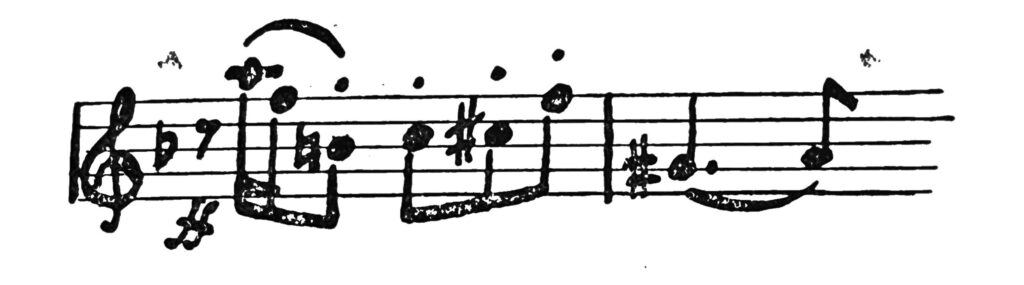
quipped the piccolo, wishing thereby — in connection with the word »demi-music« — to give a little dig at Strauss, whom he hated with fanatical stubbornness. Everyone laughed, even though »Eulenspiegel« was one of the orchestra’s favourites. It was rather the piccolo’s knack for seizing every opportunity that provoked amusement. People were accustomed to putting up with his humour and were happy to let him be obstinate. Especially as he never gave any reasons for his hatred.
However, the double bass now concluded his speech and invited those present to speak.
— The atmosphere of resentment and lack of solidarity, he added, which at present dominates the orchestra, must not be allowed to continue if we are to carry on working together. Above all, gentlemen, we must fix our position on the modern literature! It gave rise to this split and, with each passing day, increasingly favours separatist aspirations. Harmony was the orchestra’s religion. The hallmark of modern literature is — disharmony!
He had spoken himself into a frenzy. At the outset of his statement, he maintained a dignified calm and let the long sentences, heavy with many ponderous words, roll forward in a stately maestoso. But the longer it went on, the more difficult it became for him to control the tempo. His annoyance soon drove him into a bobbing six-eighths time, where the square-shaped words had too little room. Towards the end, he rescued himself with two brisk quarter notes, and he hurled out the last sentence with a force as if he meant to deliver a death-blow to the modern literature.
At least ten at once asked for the floor. There was the threat of yet another brawl, but the chairman averted the danger by handing the floor to one of the bassoons. In so doing, he also wished to prove that he intended to carry out his duties impartially. Silence fell again and the bassoon was allowed to speak.
— Esteemed colleagues, he began. According to the chairman’s view, the orchestra is threatened with dissolution. Certainly, if one views the matter as one-sidedly as the chairman does. Unfortunately, I am not so educated that I can fling around foreign phrases, but one thing I know: we do not deserve all his reproach. Furthermore, I know that many among us — that is to say, the progressive-minded — have a clear conscience. No one intends to blow the orchestra to pieces. If we have devoted ourselves with passion to the modern literature, it was only because it concerns itself, to a greater degree than the older, with the personality within each of us. As far as I am concerned, harmony in that respect does not come into it at all. Mahler’s harmonic language can hardly be called modern. Yet in some of his works, he has liberated each instrument to such an extent that the harmony arises as if by chance. For the simple reason that several instruments are playing at the same time.
— It can also become cacophony! cried the piccolo. But the bassoon continued energetically.
— And note, gentlemen, that there are passages in his score which, because of this principle, display a harmony as modern as that of Schönberg or Bartók. What is the meaning of our existence if not that each individual instrument should be allowed to develop its own character? But the prevailing laws of harmony prevent us from doing so. When one has sung oneself warm and one’s passion urges one forward, one must first ask harmony for permission to take this or that note. And therein even Mahler rightly granted a licence, as I said. Where the fault lies, I cannot say. But it is obvious that the chairman is mistaken in other respects as well. What, for example, is meant by »Mother Earth»? Is that supposed to be the orchestra? If the double basses came into being for the sake of the orchestra and exist solely as members of the orchestra, that does not mean, surely, that all the other instruments came into being in the same way. On the contrary! It is the orchestra that has come into being because the majority of us have placed our free personalities at its disposal. The orchestra as a whole is an instrument like any individual one. Its mechanism can be developed, perfected and altered. Man, the composer, has the choice. And that choice depends on his impulses. Where these come from, let him say who knows!
This was plain speaking and no mincing of words. The bassoon had been cheered on by encouraging cries from all who agreed with him. The opposing party confined itself to a contemptuous expression. Yet, however that might be, the speech had nevertheless made a certain impression. There was a moment’s pause. The chairman would have preferred to respond himself, but thought his position was strengthened if he let someone else speak in his own cause. He therefore took the opportunity to give the floor to the eldest of the violins, a veteran from Cremona.
— Signor Stradivarius, you asked for the floor a little while ago!
He certainly had not. But the bass knew that the Cremonese was philosophically inclined and liked to express his opinions. Until now, he had always strictly adhered to harmony — in the same sense as the bass himself. The latter therefore expected great help from the elder man and cleverly took advantage of the pause. The violin caught the hint and stood up.
— Although I have not asked for the floor, he said, I should nevertheless like to speak. Especially now, when I have new thoughts about various things. Many among you will surely be surprised by my words and may accuse me of apostasy —
There was a certain unease among those who had steadfastly counted on the violin.
— — — but I have always valued truth above friendship! For many years, I have been a confidant of mankind. The composers have bestowed on me their love and affection. And thanks to this position of mine, I have managed to gain insight into their courageous struggle for the development of music. The cultured person is a marvellous phenomenon. She creates laws for coexistence. Why? Because her originally free nature drives her to actions which, if allowed, would undoubtedly dissolve the social order. The laws contain commands and prohibitions and are therefore coercive. They represent humanity’s quest for harmony. But time changes man, and man — the laws. I have noticed that what was right yesterday is wrong today; what is beautiful today will be ugly tomorrow. And vice versa! All ideals are bound to their time and subject to change.
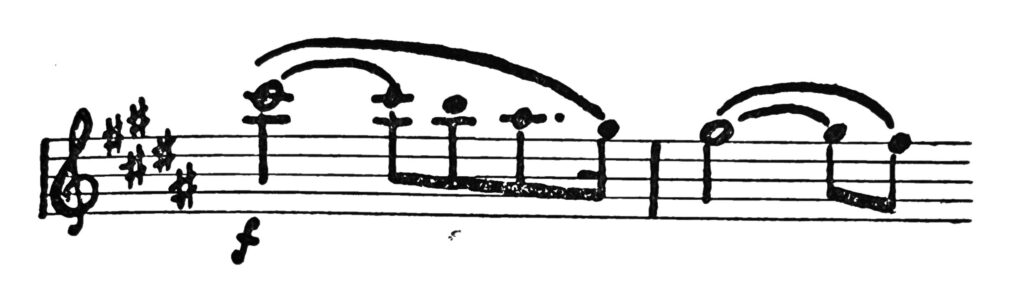
sighed the piccolo, who had suddenly become wistful.
— Proceed, Stradivarius! cried several voices at once.
The violin was grateful for the encouragement, but before continuing, he gave the piccolo a warm look. The little joker had a tear in his eye. He knew that the Cremonese understood his innermost desire: to one day be rid of his role as a prankster.
— Esteemed friends! the violin then began again. It is man who created us, along with the music of which we are servants. But just as we did not come into being all at once, neither did music. There were times when people had disputes about the third and the sixth; when the holy Church forbade the opening note of a scale from appearing at the same time as its subdominant, because the interval was considered to be tainted by the devil. The dissonant tension was said to awaken passion in the listener! Yes, you laugh! But that is how it has been. Only slowly and step by step did development take place. The gentle Mozart was attacked by a contemporary for his jarring dissonances. Even the manner of using instruments has gradually undergone change. You all surely remember the astonishment it caused when Beethoven first assigned the timpani an independent role?
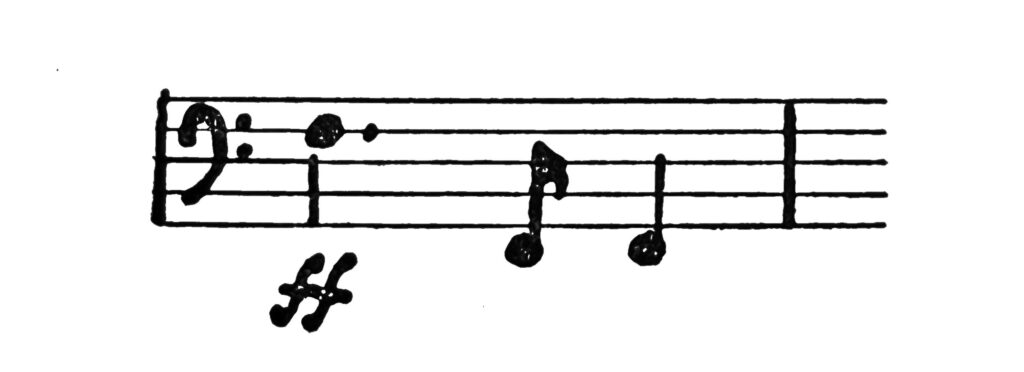
the timpani chimed in with such verve that it sounded like a fanfare.
— Not to mention the basses’ recitative in the Ninth, the violin continued. And the same tone-poet dared to realise a grand instrumental vision, whose harmonic structure defied every established rule. I am referring, of course, to the famous horn passage in the Eroica. Yes, genius has always carried art forward despite the disapproval of its contemporaries. From Palestrina through Bach, Mozart and Beethoven, onward to Liszt, Wagner and Berlioz. And from there further to Strauss, Mahler and — Schönberg.
Now doubt was no longer possible. When the violin mentioned Schönberg alongside those resounding names, murmurs of disapproval were heard from the double basses. What in heaven’s name had happened to the Cremonese? Had he gone completely mad? The violoncellos were indignant, while the other violins stood embarrassed and apparently did not themselves know what to think. But the bass clarinet had found a point of attack and was eager to strike at once.
— What are the basses grumbling about? he shouted. You yourselves are the most modern in the whole orchestra. Have you forgotten how you are tuned? E-A-D-G! A four-part chord of fourths! A pity the guitar is not here. Otherwise you might have heard how beautifully it sounds when two more strings are added above your four: B and E. And how modern!
The chairman got angry and banged his bow on the table. Everyone thought it was unnecessary to hurt the double basses. Besides, it was a flimsy attack and entirely beside the point. The Cremonese saved the situation, at least for the moment, by taking up the thread where he had been interrupted.
— Yes, in the early days mankind stumbled onto a simple harmonic system, which they developed and refined over the centuries. But one day it nevertheless proved to be an obstacle to any further progress. Its limitations were obvious. A height had been reached where every new stone meant a danger that the whole thing would collapse. Yet an irresistible creative urge drove the tone-poets to push things to the limit. And one fine day the whole building fell.
But out of the ruins rose, like a phoenix, a faint intimation of new tonal worlds. With broad wings it rose to flight and swelled into a great and liberating idea: there are no dissonances — only tone combinations! And the choice is free. The human being, the creator, listens inwardly and outwardly. Out of the concord between what she is and what she hears, the work emerges!
— But where the devil does the heart go then? screamed a violoncello, who could no longer contain himself. Is there a single modern piece in which we may sing forth from our innermost being? No! Only the mechanism is in operation, producing the most curious intervals, so that one ultimately doubts one’s ability to do justice to what is to be expressed.
— Ah-ha, ah-ha! cried the flute. I for one cannot complain. Ever since Schönberg wrote the flute solo in »Pierrot lunaire», I have been unreservedly in favour of the modern. Until then I always had a peculiar feeling when I had to tackle some of these new things. It was as if something unknown within me wanted to come forth but could not find the right tones.
— Yes, yes, there you go, interrupted the piccolo, who had come alive again. C’est le ton qui fait la musique! [It is the tone that makes the music!]
— Hush! growled the contrabassoon menacingly. This will be good, you’ll see, he said, turning to the bassoons. The flute is on the right path. And the flute continued:
— It was a new world I saw coming. The remarkable intervals, to use the expression of the violoncello, were like a splash from unknown streams of sound, whose distant murmur awakened a longing I had never felt before. Like an illness it had penetrated my body. I felt that something within me was dying, had to die, so that this inexplicable longing might be realised. And do you know, dear friends, what it was that died? Why, it was the faith in the harmony that hitherto had been our religion.
Now the storm broke loose in the orchestra. The trombones and the tuba were up in arms; the double basses sawed wildly on their E-strings; the timpani unleashed its fury in a terrible crescendo; the Gran Cassa thundered; the bassoons bellowed with delight; the other woodwinds cheered for the flute, while violins and altos poured out wailing passages. It was a terrible din. As if Belial’s children were on the loose. The chairman shouted and waved his bow to restore calm, but in vain. To make matters worse, the rest of the atonal percussion section joined in with a tremolando forte-fortissimo.
This went on for half a minute. Then suddenly the clamour ceased. As if on cue. Or rather: as if a giant hand had squeezed the orchestra’s throat.
It had grown dark in the room. But a faint light shone by the door. Upon the threshold stood a figure.
It was the Pause.
She was dressed in black, yet from the heavy folds of her robe shone a shimmer like distant lights in a pitch-black landscape. On her head she wore an ornament. It was the Fermata — a breath from infinity!
Without a sound she glided forward, and quietly she began to speak. Like a whisper the words slid through the room, while she herself grew ever more invisible, until the figure faded into the darkness:
— I am Silence, the mother. From me, streams of sound pour forth and flow quiveringly through the ether. The tone-poets listen to them. But earthly beings find it difficult to reproduce heavenly inspirations. For many, they fade into mute intimations. Others struggle to find an expression. But the form is imperfect. Laboriously it reflects a glimpse of the revealed; only a glimpse! The human spirit is shy of the supernatural. It searches cautiously for reason to cling to. But all that is divine stands above reason.
Few have the courage to abandon themselves to the creative work I inspire them to. Only the heroes have dared to do so. But even they have battled against prescribed laws until, in sacred zeal, they have succeeded in creating immortal works. Immortal because they were born from the current of air from my breathing. In them lives the pulse of all things, and therefore they shall never perish.
Eternal streams of sound shall flow from the bosom of silence. New poets shall come. They too will listen, until their language becomes another. Richer! And the old instruments shall change or die. Silence gives birth to the song of infinity. Do you want to sing? Can you grasp it? Rich, rich — — —.
The last sounded as if thousands of voices had sung a scarcely audible pianissimo in unimaginable intervals. For a moment, the instruments had listened to new tone-worlds, whose infinite riches of strange sonorities and wonderful melodies had awakened a troubling awe.
Gradually it grew light again. The figure was gone. But no one could utter a sound. Silently, they said their goodbyes and parted with heavy hearts.
The celesta was the only one who remained. She struck a few chords slowly and dreamed of new worlds. She felt like the only one in the orchestra whose longing for the supernatural had found expression.
Moses Pergament, Svenska Dagbladet, August 19 19231