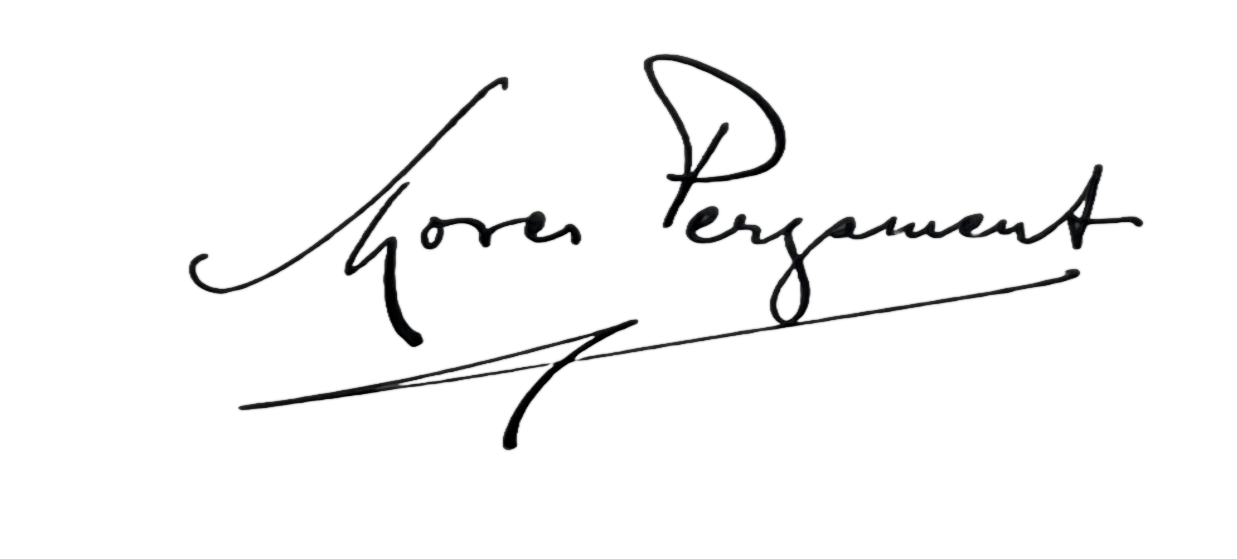
A biographical sketch
By Martin Malmgren, originally published by Toccata Classics.
Moses Pergament was born in Helsinki on 21 September 1893, into a Jewish family originating from the Lithuanian village of Ukmergė, north-west of the capital, Vilnius. There was no lack of musicians in the family: his younger brother, Simon Parmet, studied conducting and eventually became conductor of the Finnish Radio Orchestra in 1948–53; his future step-brother, Matti Rubinstein, also became a conductor; and his niece, the pianist-composer Erna Tauro (née Pergament), became active in the world of music-theatre, and is remembered in particular for her songs based on Tove Jansson’s ‘Moomin’ books. Pergament himself originally aimed at a career as a violin virtuoso, and after studies with Victor Nováček – the Czech violinist who premiered the first version of the Sibelius Violin Concerto – he entered the St Petersburg Conservatoire with hopes of joining the class of the legendary violinist Leopold Auer. As Pergament’s biographer Carl-Gunnar Åhlén notes,1 it appears that Moses initially was offered a place in the class of Ionnes Nalbandian, Auer’s Armenian assistant.2 It is highly likely that Pergament was in Nalbandian’s class at the same time as a very young Jascha Heifetz, likewise of Lithuanian origin, who, unlike Pergament, would soon move on to Auer’s class.3
In the unpublished memoirs that Pergament wrote towards the end of his life, of which Carl-Gunnar Åhlén cites fragments in his biography, the composer offers this explanation of his unusual family name:
My grandfather was drafted into the Russian military at the age of nine, as the Russians did with all the Jewish boys in the Russian and Polish Jewish villages. Conscription in Russia at that time lasted 25 (!) years. My little grandfather was asked at enrolment what his name was. Mosche Parmet, he answered truthfully. Parmet – what is that? the Russians wondered. It’s what you write the handwritten Torah scrolls on (the Bible text). Ah, Pergament it is!4 Then you can be called Pergament too. That’s how we and many others got their surnames. The Russians thought it was simple and painless.5
In the same memoirs, Pergament explains how his practising experiments during this time led to the development of lymph nodes on his left hand, which he claims put an end to further violin studies.6 What was meant to be four years of studies became three, and Pergament returned to Helsinki, where he entered the Helsinki Music Institute (later the Sibelius Academy) in September 1911 and received lessons from Erkki Melartin in music theory.7 For a brief period, he also studied at the Helsinki University. In spite of his hand injury, his violin studies were continued – now with Leo Funtek, who had succeeded Nováček. Nor did the injury prevent him from playing in the Helsinki Philharmonic Society, nowadays the Helsinki Philharmonic Orchestra. One could therefore assume that Pergament remained a capable violinist but that he no longer envisaged a virtuoso career for himself.
He was also part of a circle of composition students of Ilmari Krohn, which included Yrjö Kilpinen, Väinö Raitio and Matti Rubinstein. The group was eventually disbanded because of Krohn’s demand for absolute fidelity from his students,8 but Pergament would remain friends with Yrjö Kilpinen over the next decades, describing him as ‘Finland’s Hugo Wolf’ in his later position as music critic.9 Pergament liked to refer to himself as an autodidact, and so one can assume that these early composition lessons had a limited impact on his development.
In the days preceding Pergament’s debut concert as a composer, held in the Great Hall of the Helsinki University in December 1914, a well-known figure in Finnish music life writes in his diary: ‘Another new composer, in addition to that a Jew, Moses Pergament. Hufvudstadsbladet – the Jewish paper by preference – puffs’. After the highly successful debut, which was sold out to the last seat and where many works on the programme had to be encored immediately, another entry in the same diary mentions Arthur Frenckell, the editor-in-chief of Hufvudstadsbladet who happened to be Jewish:‘Our Swedish press cheers for Moses Pergament. Frenckel [sic] directs and patronises his tribe; in fact the most powerful on earth. The Finnish press dares to tell the truth, but will probably have to eat it up’.10 The author of these diary entries was none other than Jean Sibelius. His words serve as an example of the anti-Semitism Pergament had to face throughout his life, either directly or in a less overt manner.11 In spite of all of its apparent qualities, his music remains scarcely known to the general public even today, and the extent to which prejudice and outright discrimination played a part in his marginalisation can hardly be overestimated. Pergament would become widely appreciated for his insightful writings on music in his ‘day job’ as a music critic and contributed enormously to Swedish musical life in this role, but as a composer he was hardly given a warm embrace by the domestic musical establishment after making Sweden his home in 1915. Because of his place of birth, some were unwilling to consider him a Swedish composer, although Swedish was his mother tongue and he had been granted Swedish citizenship in 1919.12 His friends Hilding Rosenberg and Gösta Nystroem brought up his name before the Society of Swedish Composers numerous times, but it took no less than three decades for Pergament to become accepted as a member, in May 1945 – its first Jewish member, in fact. Doors that had previously been closed to him now started to open, and the composer, already more than 50 years old, began to receive commissions more frequently.
Pergament’s move to Sweden in 1915 was in part an effort to avoid being conscripted into the Russian army when the First World War was unfolding, as his grandfather had been.13 Pergament managed to get a suspension by bribing a military doctor, a purchase that included a false passport.14 In the autumn of 1915, he travelled through Torneå- Haparanda in the north and arrived safely in Stockholm. Here he would soon be taken under the wing of the Finnish composer-conductor Armas Järnefelt (Sibelius’ brother- in-law, as it happens), whose letter of recommendation probably played an important role in Pergament’s successful application for Swedish citizenship. With paternal care, Järnefelt helped Pergament to find his place in this new environment, allowing him to sit in at the Royal Opera in Stockholm to follow Järnefelt’s rehearsals with the orchestra. As Åhlén notes in his biography,
To the left side of the conductor [Järnefelt] sat Moses’ violin teacher Leo Funtek as alternating first concert-master. He had been forced to emigrate to Sweden after Austria’s declaration of war on 6 August 1914 since he was born in the Austrian-Hungarian Ljubljana/Laibach and therefore belonged to the enemies of the Grand Duchy of Finland.15
Approximately thirteen years after Pergament’s move to Stockholm, his 1921 ballet Krelantems och Eldeling16 for large orchestra would receive its belated premiere on that very stage of the Royal Opera, with decoration and costumes by Gösta Adrian-Nilsson. After relocating to Stockholm, though, the young cosmopolitan composer was far from ready to settle down: he would soon spend time in the lively cultural milieu of Paris, attending the 1920 production of Stravinsky’s The Rite of Spring at the Théâtre de Champs-Élysées with Sergei Diaghilev’s Ballets Russes. As Pergament recalled the event in his later years, the violent reaction of the audience appeared to be of the same variety as the brawls that had accompanied the 1913 premiere of the work in the same venue:
they were fighting on the parquet […] with their fists, so there was a battle all over the auditorium. […] We sat at the top, it was one of those little ox-eye windows up in the gallery, and we howled with all our strength in enthusiasm, complete dissolution. We thought it was so fantastic. Now it wasn’t just the concert version, it was the Russian Ballet that danced the work, and it was probably very much the enormous intensity of the dance that made us so moved.17
Not long thereafter, Pergament appears to have made contact with Diaghilev himself, and to have interested him in collaborating on a ballet, making Pergament the only Finnish- born composer to have received a commission from Ballets Russes. It was around this time that he wrote not only Krelantems och Eldeling but also started sketching a second ballet, Revolution. It is unclear how events unfolded, but the Ballets Russes underwent a split and never programmed Krelantems och Eldeling before its dissolution in 1929. Pergament must already have lost all hope with the Ballets Russes, since he had started looking for alternative venues for a production years before the company was disbanded, and thus the work was eventually premiered in 1928 in Stockholm. The ballet master at the Royal Opera at the time was the Polish-born dancer, choreographer and author Jan Ciepliński, who had been dancing for the Ballets Russes in 1925–27. In spite of the difficulties of dancing in Gösta Adrian-Nilsson’s costumes, Krelantems och Eldeling was a resounding success with the audience, with no fewer than thirteen curtain calls.18 Although a 24-minute ballet suite version was later recorded, it seems that the full ballet has not been performed since that belated premiere.
Pergament also spent some years studying conducting in Berlin, where he met his future wife, Ilse Kutzleb. They married in 1923 and had three children; she died in 1960. It could be argued that Pergament was more strongly influenced by German culture than by French, as exemplified by his long list of songs to German poetry, compared with only one song in French. After the Second World War, however, he did not set a single song in German. When composing a song to text by Otto Julius Bierbaum in 1973, whose poetry Pergament had set to music many times in the first decades of the twentieth century, he made his own translation of the text into Swedish. His L’infidèle, to a text by Maeterlinck, is from 1951, a set of Four Chinese Songs date from 1946, and in his final decade he became preoccupied with writing songs in Italian – a shift of focus strongly suggesting that the traumatic experiences of the 1930 and ’40s led Pergament to search for inspiration elsewhere. There is a telling letter from him to Konrad Latte, a German- born musician who was among the few Jews in Berlin to survive the war, thanks to a network of people who helped him hide.19 Latte remained in Germany after the war and considered performing Pergament’s magnum opus, the thirteen-movement choral symphony Den judiska sången (‘The Jewish Song’; 1943–45), for soprano, tenor, chorus and orchestra, which was written at the height of the Second World War. Pergament responded that it was a highly demanding work for large forces, and instead referred to some of his smaller compositions on Jewish subjects. He then added a bitter remark: ‘When it comes to presenting my music to Jews in Germany, I’m happy and grateful. But I have no interest in German audiences’.20
Upon his return to Sweden in the early 1920s, Pergament took up a position as music critic for the Swedish daily Svenska Dagbladet. Although he never felt at home in this role, his poetic and informative writings were of considerable cultural-historical importance, since they opened the ears of Swedish listeners to the sounds of contemporary music from the continent. Pergament has frequently been praised for his factual and impartial manner of writing – he appears to have had little difficulty in giving critical reviews of personal acquaintances nor positive reviews of people whom he found antipathetic.21
It is as a writer that Pergament the Renaissance Man becomes most apparent. When offering in-depth analysis of a singer’s vocal technique, his own experiences included having followed the costly lessons of his first fiancée, the mezzo-soprano Esther Bramson, with such luminaries as Jean de Reszke and Madame Charles Cahier; when reviewing violinists, he could compare them with the standard of his personal friends in Leopold Auer’s class; and when reviewing new music, he was clearly capable of giving a qualified opinion on form and orchestration after years of study, as well as experience as both orchestral musician and conductor. But beyond the purely musical, his reviews would often become multi-layered in their references to literature, poetry, philosophy, film, history and so forth.
It is difficult to ascertain what were the primary and what the secondary motivations for Pergament’s marginal place in Swedish musical culture. As a Jew, he had to live with anti-Semitic attacks most of his life; as a foreigner, it took him a long time after moving to Sweden until he became fully accepted as a Swede. It comes as little surprise that a particular kind of humanism and inclusive attitude is evident in his writings, as illustrated by a 1947 review of a concert by the African-American singer Todd Duncan: ‘In art, the colour of one’s skin is not decisive. Thank God. For those with soul, talent and technical skill, the field is open. Any man and any state that seeks to delimit the domain of art with barbed wire should, in the name of true humanity, be branded a criminal’.22 At the same time, one wonders if it merely a coincidence that Pergament began identifying with Swedish culture in his musical works from the late 1920s for over a decade onwards23 – a period during which Pergament’s own Swedishness was repeatedly questioned.24
It could also be said that Pergament’s sincerity and fearless attitude earned him both friends and enemies. In 1929, having been called a ‘foreign parasite’ in a review by the composer-critic Wilhelm Peterson-Berger, Pergament went to Peterson-Berger’s home and, on the spur of the moment, slapped his face – an event that made him famous overnight and led to caricatures and articles in the press. Letters of support came to both Pergament and his counterpart. His razor-sharp reviews and opinion pieces sometimes had far-reaching effects: a highly critical review of a performance by the violinist Henri Marteau in 1930 resulted in Marteau’s cancelling the remainder of his tour in Sweden.
When Wilhelm Furtwängler was invited to conduct Beethoven’s Ninth Symphony in the Stockholm Concert Hall in December 1943 and there were calls to boycott a concert conducted by a German musician reputedly close to the Nazi authorities, Pergament was one of the few who came to his defence:
Rarely has the gap between dream and reality, between poem and life, widened so violently as it has here. It is certainly not with the ‘wing of joy’ that fate is wafting over the troubled human race. What Schiller and Beethoven dreamed of was perhaps a utopia, doomed to remain so forever. But it was nevertheless the creed of the humane German spirit, a glittering flow from the source of the deepest wisdom and the noblest emotion – goodness. The goodness that connected minds, hearts and hands across the social and national barriers of understanding, sympathy and higher fellowship.
The man who tore up the title page of the Eroica on the grounds that an autocrat who allows himself to be ruled by his egotism can only be an oppressor and is therefore not worthy of the dedication, that man would never have wanted to serve as a cultural messenger for a regime whose theories of struggle are based on terror and spiritual obfuscation. ‘Nicht diese Töne!’ he would have shouted at them. And if it had been in his power to defy them, he would have climbed the imperishable German platform walled by Lessing, Schiller and Goethe, and from there sung out to the world that ‘Alle Menschen werden Brüder’ and ‘Seid umschlungen, Millionen!’
When Furtwängler comes to us in this dark hour with Beethoven’s Ninth Symphony – the cosmopolitan confession of the German tongue, which spreads a little light and warmth in our souls and gives crutches to our mutilated faith in a universal will to good – I cannot free myself from a thought that plays in my mind: the man is consciously or unconsciously, intentionally or unintentionally doing the bidding of Beethoven and Schiller! A call for a boycott against him was almost published in the newspapers. What stupidity! Now I realise that his performance of the ‘Ninth’ could not have come at a better time. After all, it is the most powerful protest against violence and misrule, hatred and inhumanity to man, ever uttered in the common language of thought and feeling.25
Another reason for Pergament’s marginal position in Swedish musical life could be more difficult to prove: professional jealousy. When he was hired as music critic for Svenska Dagbladet, no fewer than five members of the Society of Swedish Composers – Kurt Atterberg, Natanael Berg, Oskar Lindberg, Ture Rangström and Patrik Vretblad – went to the editor-in-chief to complain that the paper had hired someone completely unknown, who additionally wasn’t Swedish-born. In true altruistic fashion, the mighty five suggested that one of them – Ture Rangström – should instead get the job.26 By Swedish standards, Pergament was an impressively cultivated, knowledgeable person who before his thirties had seen more of the world than many elderly local composers had seen in their lifetime. It is perhaps of little surprise that this highly successful ‘foreign parasite’ was not greeted with open arms by everyone in the Swedish music establishment.
Pergament’s institutional acceptance through his membership of the Swedish Society of Composers in 1945 came soon after he had completed Den judiska sången. During the war, he also formed a Jewish orchestra and choir from refugees from the Third Reich, which he led together with his singer and cantor friend Leo Rosenblüth, who was himself a composer.27 At this time, he also befriended the writer Nelly Sachs, who had been able to flee Nazi Germany at the last minute, thanks to the intervention of the Swedish author Selma Lagerlöf and others. This friendship resulted in two operas written to librettos by Sachs: Eli and Abram’s Erwachen oder Sehnsucht aus Durst (‘Abraham’s Awakening or Longing through Thirst’) – the latter still awaits a performance.
Other works of note from his later years include a cello concerto (1955) written for the renowned Catalan cellist Gaspar Cassadó, the oratorio De sju dödssynderna (‘The Seven Deadly Sins’; 1963), based on poetry by Karin Boye,28 a piano concerto (1952),29 a concerto for two violins and chamber orchestra (1954), three of his four string quartets (1952, 1956/1967 and 1975), choral music, songs and much else.
Pergament also published four books on music during his lifetime: Svenska tonsättare (‘Swedish Composers’), På vandring med Fru Musica (‘On a Walk with Mrs Musica’), Ny vandring med Fru Musica (‘New Walk with Mrs Musica’), and a Jenny Lind biography.30 In his late years he also intended to publish a book entitled Quo vadis, Musica?, which among other things was meant to include a lecture about Nelly Sachs and a series of composer portraits, but no publishers appear to have shown interest. Outside Sweden, Pergament the writer is perhaps as obscure as Pergament the composer.
Although Pergament’s music did begin to be performed more often later in his life, it fell back into neglect after his death, on 5 March 1977. His life-story is filled with examples of intolerance and discrimination, and one wonders to what extent his career would have turned out differently without such prejudice. This series of recordings will, we hope, help atone for past wrongs by making it possible to re-evaluate the life and music of Moses Pergament.
- Carl-Gunnar Åhlén, Moses Pergament, Gidlunds Förlag, Möklinta, 2016, p. 30. ↩︎
- The preparatory course was given by ‘a certain Kogan’, according to Pergament (ibid., p. 29) – but not Leonid, who was not born until 1924. ↩︎
- Heifetz entered Nalbandian’s class in 1910, at the age of nine. In a review in Svenska Dagbladet on 4 April 1934, after a Heifetz performance of the Beethoven Violin Concerto in Stockholm, Pergament notes that Heifetz was ‘a mature artist already at the age of 10, a medium for higher inspirations’. ↩︎
- The Russian пергамент is ‘parchment’ in English. ↩︎
- Åhlén, op. cit., p. 19. This passage also explains why Simon Parmet, né Pergament, called himself Pergament-Parmet for a while, before eventually adapting the simpler surname of Parmet. The change is said to have taken place in the 1920s on the advice of a German conductor while Parmet was studying in Germany; it is believed that the change of surname was intended, at least in part, to distinguish himself from Moses. ↩︎
- Åhlén, op. cit., pp. 30–31. ↩︎
- According to Åhlén, Pergament had lessons with Melartin in both music theory and composition, but the newspaper articles from Pergament’s debut concert in 1914 present him as a self-taught composer. Writing under the pseudonym BIS, Karl Fredrik Wasenius (a great-grandfather of Robert von Bahr, who named his renowned record label in memory of his ancestor, and whose very first recordings were of music by Moses Pergament) referred to Pergament in a review as ‘a pupil of Melartin in regards to earlier theoretical studies, in composition his own teacher’ (Åhlén, op. cit., pp. 31 and 37). ↩︎
- Ibid., p. 34. ↩︎
- ‘Yrjö Kilpinen – Finlands Hugo Wolf’, Svenska Dagbladet, 26 September 1926. ↩︎
- Diary entries on 19 November and 3 December 1914, Jean Sibelius: Dagbok 1909–1944, ed. Fabian Dahlström, Atlantis/Society of Swedish Literature in Finland, Porvoo, 2005, pp. 204 and 206. ↩︎
- It should be pointed out that Pergament came in contact with Sibelius in many ways, both directly and indirectly, throughout his life, and beyond these diary entries there is no evidence of a demeaning attitude from Sibelius towards Pergament – on the contrary. For his part, Pergament adored Sibelius’ music and interviewed him in his later job as music critic, and Sibelius symfonier: en studie i musikförståelse (Söderström, Helsinki, 1955; an English translation appeared as The Symphonies of Sibelius – A Study in Musical Appreciation, published by Cassell, London, in 1959), perhaps the most influential book on the interpretation of Sibelius’ symphonies, was written by Pergament’s brother, Simon Parmet, as a result of his many visits to the composer in his home in Järvenpää, where he sought advice on the music. In a later diary entry Sibelius was complimentary about Pergament’s talents. ↩︎
- Jews were not able to become citizens in Finland until 1918. By then, Pergament had already applied for citizenship in Sweden. ↩︎
- Finland was a ‘Grand Duchy’ of Russia for over a century, until 1917, when it won its independence. ↩︎
- Åhlén, op. cit., p. 38. ↩︎
- Ibid., p. 43. ↩︎
- Åhlén describes the ballet as a classical triangle drama:
The young, adored folk hero Krelantems […] loves the dancer Eldeling […] and has his feelings reciprocated. His rival is the brutal and tyrannical King […] who uses her to chase away his gloom. Neither grand feasts with dances, jesters’ parades, fighting games or masked games amuse him for long; his only wish is that Eldeling dance for him. Krelantems rushes towards the King with his sword but is overpowered by the guard. Eldeling is left alone with the King who becomes increasingly violent. In a vision she sees Krelantems taken away and finds new strength, but when the King realises that he cannot subdue her, he orders Krelantems to be killed and the body to be carried into the palace. Eldeling collapses when she sees the corpse with Krelantem’s helmet. The King realises that it is now his turn to use her. But a signal sounds, it grows dark, and Krelantem’s followers enter the palace and kill the King. The corpse on the stretcher was the Fool […] who played dead and who now dances a dance of joy. Ibid., p. 88 ↩︎ - Quoted in Anders Edling, Franskt i svensk musik 1880–1920, Almqvist and Wiksell, Uppsala, 1982, pp. 313–14. ↩︎
- Letter from Pergament to Gösta Adrian-Nilsson on 21 March 1928. Adrian-Nilsson was ill at the time of the premiere and could not attend. ↩︎
- It is believed that approximately 2,000 Jews lived through the war in Berlin – Konrad Latte was one of them, but Pergament would have been unaware of his fate at the time of their exchange of letters. Latte’s remarkable life-story can be read at ‘Saving Konrad Latte’, The New York Times (nytimes.com). ↩︎
- Letter from Moses Pergament to Konrad Latte, 23 July 1951; accessible at https://www.taminoautographs.com/products/pergament-moses-typed-letter-signed-1951/. ↩︎
- Countless examples of appreciation for Pergament’s honest way of writing can be found among letters from readers, colleagues and others in the Moses Pergament archives of the Music and Theatre Library of Sweden, located in Stockholm. Many of the letters quoted here can be found in these archives. Recalling his first years as a critic, Pergament wrote: ‘During a voluntary but nevertheless fanatical tactic of isolation from all publicly performing musicians, I had managed in a few years to gain a reputation as an absolutely impartial and unbiased reviewer’ (Otto Järte sjuttio år: från vänner den 10 oktober 1951, Svenska Dagbladet, Stockholm, 1951, p. 61). ↩︎
- From a review by Pergament of a Lied recital by Todd Duncan in Stockholm on 27 September 1947. The Kentucky-born Duncan (1903–98) created the role of Porgy in Gershwin’s Porgy and Bess in 1935 (having been chosen by Gershwin himself) and sang the role more than 1,800 times. ↩︎
- Works from this period include a Swedish Rhapsody for orchestra based on folk-tunes from the region of Dalarna, arrangements of Swedish folksongs and arrangements for chamber orchestra of the Swedish author and amateur musician Carl Jonas Love Almqvist’s piano works. ↩︎
- In a letter of 11 March 1926 to Pergament, the Swedish composer Kurt Atterberg writes: ‘I could not have dreamed that you would launch yourself as a Swedish composer […]. So far, you are a purely Jewish composer for the sake of principle – why not in name as well?’ Having Swedish citizenship and having works published under the heading ‘Swedish compositions’ was not enough for Atterberg, arguing that for Pergament to become a true ‘representative of our music, you should also show your affinity and appreciation for our music and preferably also do something positive for it’. The two men would later be reconciled, and Pergament remained on good terms with Atterberg for the rest of his life, not least at the time when Atterberg fell from grace in parts of the Swedish musical life after the Second World War because of his contacts with composers and music organisations in Nazi Germany. ↩︎
- ‘Nicht diese Töne!’, Aftontidningen, 6 December 1943. Pergament would be heavily criticised for his stance, also after the war, and was even construed as a Nazi accomplice by the writer Moa Martinsson. A more in-depth discussion can be found in Henrik Rosengren, Judarnas Wagner: Moses Pergament och den kulturella identifikationens dilemma omkring 1920–1950, Sekel Bokförlag, Lund, 2007, pp. 319–27. ↩︎
- Åhlén, op. cit., p. 72. It is also worth noting that the board of Svenska Dagbladet devoted time in no fewer than seven meetings to discuss whether or not it would be appropriate to hire a person whose name might sound like a pseudonym to many readers. ↩︎
- In 1973 an LP of Jewish Liturgical Music by Rosenblüth (1904–2000) became the first-ever release of the Swedish record label BIS. His compositions include a folk opera, Sulamith (1931), and choral music (much of it liturgical) as well as incidental music for radio and the theatre. ↩︎
- Born in Gothenburg in 1900, Boye moved to Stockholm as a child. An antifascist already as a student, on a visit to Germany she was inspired by the growing Nazi movement to write the novel Kallocain (1940), which predates Orwell’s Nineteen Eighty-four in its portrayal of a totalitarian society. De sju dödssynderna was the fifth and final anthology of Boye’s poems, left unfinished at the time of her suicide in 1941. Karin Boye became a link between Pergament and Nelly Sachs, who would later be awarded the Nobel Prize in Literature: Sachs contacted Pergament after having read his critical review of a German translation of Karin Boye’s poetry. ↩︎
- Ideas for a second piano concerto, in 1975, occupy only a few pages of music. Pergament notes in his diaries that it was ‘commissioned’ by the Polish pianist Bella Horn, at the time engaged to the Spanish pianist José Ribera. He was among the few who performed Pergament’s first and only completed piano concerto during Pergament’s lifetime. Upon my inquiry, Horn expressed surprise to hear that Pergament had begun writing a piano concerto for her. In a phone call I made to José Ribera on 21 November 2022, he explained how the young couple would sometimes spend evenings together with both Pergament and the Austrian-born composer Hans Holewa, whose music the pianists also performed and premiered. One could perhaps imagine that an idea for a commission came about during one of these gatherings, but never developed beyond the sketches and was abandoned by the aging composer. ↩︎
- Svenska Tonsättare, Hugo Gebers Förlag, Stockholm, 1943; Vandring med Fru Musica, P. A. Norstedt & Söner, Stockholm, 1943; Ny vandring med Fru Musica, Norstedt, 1944; Jenny Lind, Norstedt, 1945. ↩︎