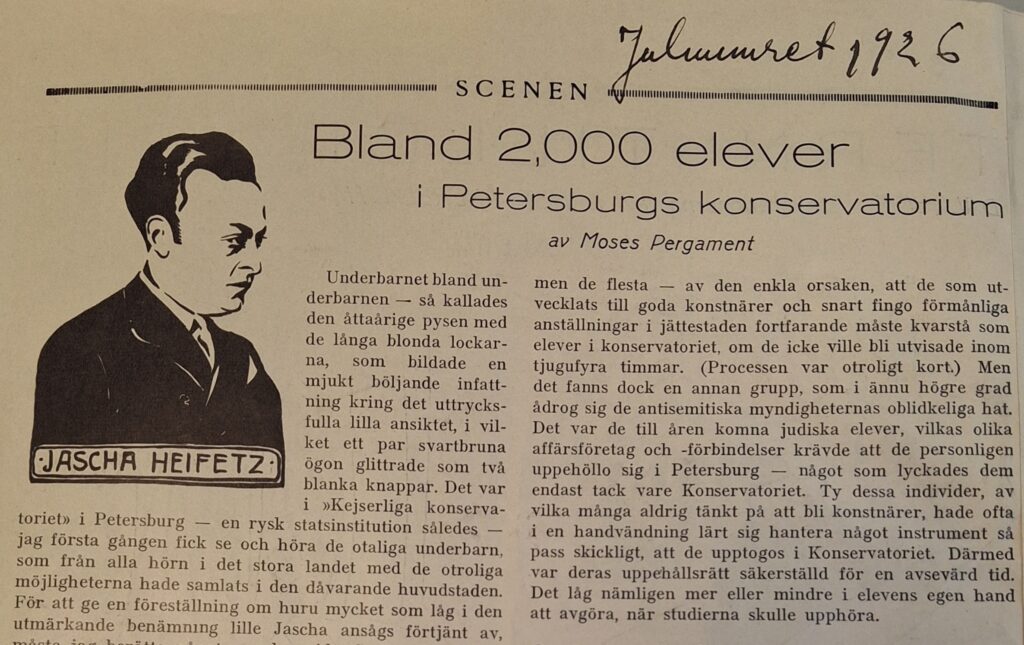
Among 2,000 Pupils at the Petersburg Conservatoire
by Moses Pergament
The wonder-child among the wonder-children — so they called the eight-year-old little chap with long fair ringlets that softly framed his expressive face, and in which a pair of dark brown eyes sparkled like two polished buttons. It was at the “Imperial Conservatoire” in Petersburg — a Russian state institution, that is to say — that I first saw and heard the many prodigies who, from every corner of that vast country of incredible possibilities, had gathered in the then capital. To convey an idea of what was implied by the distinctive sobriquet little Jascha was deemed to deserve, I must say something about the remarkable institution which went under the name of the Petersburg Conservatoire.
The Russians are an extraordinarily musical people, as everyone knows. But in their vast fatherland there dwell many other peoples who need not be ashamed of their musical gifts. Among these the Jews stand foremost. Under the ancien régime, however, they were for the most part without rights in Russia. Only those Jews whose ancestors had been in the service of Nicholas I enjoyed the priceless privilege of being able, untroubled by gendarmes and the secret police, to reside in all the cities of the realm — Moscow and Petersburg included. All the others lived at the mercy of the authorities and were confined to the more remote provinces, where, as artisans, peasants and traders, they endured lives full of sorrow, privation and bloody pogroms.
Ninety per cent Jews among the pupils
Curiously enough, the Conservatoire in Petersburg became one of the focal points of interest for these oppressed Jews. Strange, indeed — for by Western standards the circumstances that contributed to this were, to say the least, peculiar. The Conservatoire had the authority to secure the right of residence in Petersburg for any Jew admitted as a pupil to one of its classes. This explains the otherwise inexplicable fact that among the nearly two thousand pupils who in my time attended the school — a school much sought after by violinists — no fewer than ninety per cent were Jewish.
Jewish applicants generally found it easiest to pass the often extremely demanding entrance exams. And once admitted, it was virtually impossible to get them out of there. Not all, but most — for the simple reason that those who developed into good artists and soon obtained favourable posts in the great city still had to remain registered as pupils of the Conservatoire if they wished to avoid being expelled within twenty-four hours. (The process was incredibly quick.) But there was yet another group which incurred the implacable hatred of the anti-Semitic authorities to an even greater degree. These were the elderly Jewish pupils whose various business enterprises and connections required their personal presence in Petersburg — something which they achieved only through the Conservatoire. For these individuals, many of whom had never intended to become artists, had quickly learned to handle some instrument well enough to be admitted to the Conservatoire. Thereby their right of residence was secured for a considerable time. It lay, indeed, more or less in the pupil’s own hands to decide when the studies should cease.
A Switzerland for persecuted Semites
Thus the Petersburg Conservatoire became, in effect, a little Switzerland for the persecuted Semites. It swarmed with odd types. When I first entered the great corridor on the ground floor, I fancied I had wandered into a stock exchange. Everywhere men stood in little groups and discussed business. The smattering of Russian I had acquired by then gave me a glimpse of what they were talking about. On my first day I was viewed with some suspicion, but after a few days an older pupil came up to me with a discreet question as to whether I might not require his assistance in some transaction. At that moment I understood nothing but my Swedish mother-tongue and thus saved myself from further trouble.
It was perfectly natural — that is to say, from an anti-Semitic point of view — that the Russian government should endeavour to effect a radical change in this vital “art question”. During the short time I studied at the Conservatoire the authorities attempted no fewer than three times to revoke this asylum for Jewish pupils. Vain efforts, for each attack rebounded upon the determined veto of the teaching staff. “If the Jews shall be sent away,” they answered, “then we may as well close the shop.” The Conservatoire’s world-fame rested, in the first place, upon the Jewish violin teacher Leopold Auer and his outstanding pupils, the Jewish prodigies. Russian nationalist propaganda could do nothing against the simple fact that the Russian teachers, led by a Rimsky-Korsakov and a Glazunov, threatened to resign if any new regulations were enacted that deprived Jewish pupils of the possibility of continuing their studies.
At the Russian universities rigorous methods had been employed to reduce the number of Jewish students to almost nil. It was stipulated that only three per cent of a university’s intake might be Jewish. But to be admitted at all, these had to have left school with a gold medal! Despite the arbitrariness and the anti-Semitism of the Russian schools, the Jewish “medal-students” were numerous. There would have been enough to allow for a fifteen per cent proportion of Jews at the universities.
Three prodigies in one family
At the Petersburg Conservatoire the reverse was true in every respect. There were even several Jewish pupils who, together with their parents, had all their living expenses paid by the Conservatoire. One such pupil was, among others, the now world-famous Mischa Elman. As a rule, the truly gifted were so poor that without this support they could not possibly have existed. I knew a family in which there were no fewer than three prodigies — two boys and a girl, namely two violinists and a pianist. The Conservatoire maintained them in part and presented the girl with a Steinway grand, for she had no instrument on which to practise.
The wonder Jascha Heifetz
We have now at last arrived at the point at which this article ought really to have begun. Among all the prodigies who over the years brought renown to the Petersburg music school, Jascha Heifetz stood alone. The ten-year-old Elman had astonished all by his phenomenal technique. The slightly older — Zimbalist, Achron, Laserson, Cherniavsky, Piastro; and later Kathleen Parlow, Cecilia Hansen and others — all possessed in one respect or another admirable artistic qualities. But a marvel such as that wrought by the eight-year-old Jascha Heifetz had never even before been seen in Petersburg. Here there was united an absolutely pre-eminent technique with an artistic power of interpretation which made one believe in the transmigration of souls. Hardly otherwise could one explain the precocious artistry of a normal, playful child who, as soon as he set the violin to his chin, was transformed as it were into a mature and profound interpreter of the joys and sorrows of the human heart. That which is not written in the notes, that which can never be taught, that which has streamed from the innermost depths of the composer’s soul and is but inadequately hinted at by markings and all manner of defective performance-directions — that the child seized and brought to light with a naturalness and a living vividness that made the heart tremble with a wonderful experience.
Heifetz has now grown to manhood. His art remains as brilliantly superior as before, although the halo of wonder no longer hovers about his neatly cropped head. Yet even if he has lost his long fair locks and the child’s entrancing innocence — so strangely at variance with the worldly experience and depth of feeling in the eight-year-old’s playing — the playing has not materially altered, certainly it has not been trivialised — despite America, the dollars and world-fame. The real difference is that the prodigy has become a man: a composed, controlled artistic personality, fully conscious that what he produces is among the finest and noblest possessions of human existence. To live in such consciousness should bestow upon him the greatest happiness conceivable in this vale of tears.
Moses Pergament, Scenen, Christmas issue 1926. Translated by Martin Malmgren from the original Swedish article ‘Bland 2,000 elever i Petersburgs konservatorium’ 1
- Music and Theater Library, Stockholm, A640, Vol. 12 ↩︎