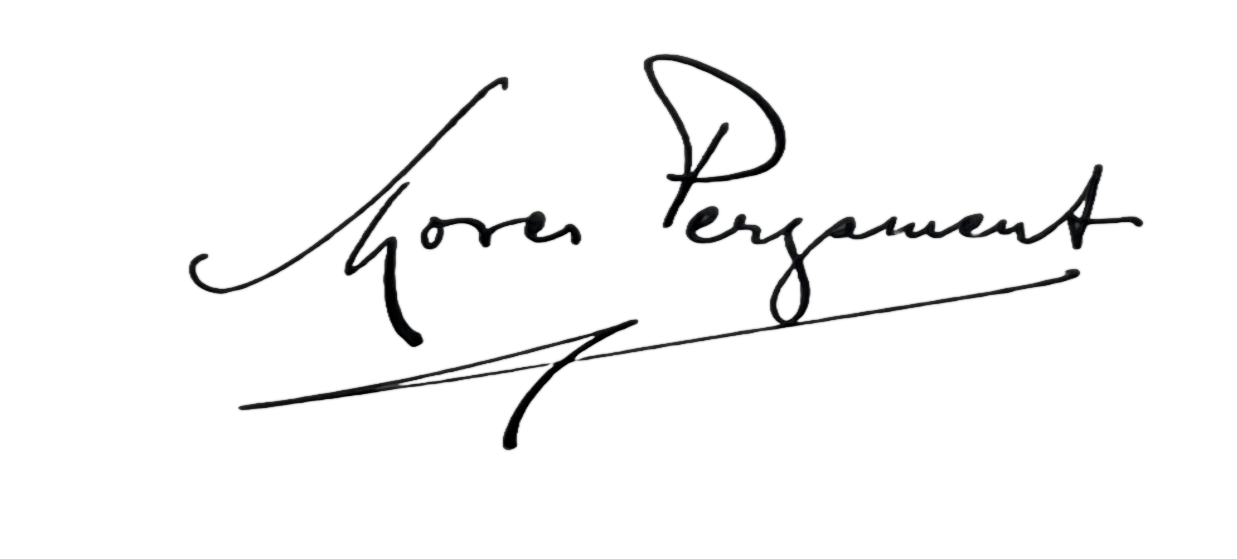
Review of Moriz Rosenthal’s piano recital and subsequent letter from Rosenthal to Pergament
In his work as a music critic, Moses Pergament grew accustomed to receiving both supportive letters and harsh criticism of his opinions and writings. In rarer cases, the artists themselves responded to his reviews. One such preserved exchange concerns the Polish pianist Moriz Rosenthal — a pupil of Franz Liszt and the Chopin student Karol Mikuli — after Pergament published a critical review of Rosenthal’s piano recital in Stockholm in 1933. Below is a translation of the review (originally published in Swedish), followed by Rosenthal’s response (written in German, transcribed and translated by Ronen Shifron). It is not known whether Pergament ever responded to Rosenthal’s letter.
Moriz Rosenthal is, despite his seventy years, a man of prodigious strength. When, with the springy elegance of the born virtuoso, he strikes down fortissimo-heroically with his enormous paws upon the keyboard, the black swan—the grand piano—shudders and beats its single wing in mortal anguish. “I cannot fly,” it sighs, “if you strike me so mercilessly.” Fortunately, not every composer demands of his interpreters that they wrest Promethean forces from the mute language of the printed score. In the shadow of Beethoven, Rosenthal becomes a violently clamorous pounder of the keyboard. He misunderstands the titan! It is not in physical power, but in the strength of thought and feeling, that Beethoven’s mighty spirit reveals itself. In the company of Chopin, Rosenthal’s poetry blossoms forth in all its romantic splendour. Here his playing seems suddenly transformed; it shines and warms and shimmers in all the colours of the rainbow. Even power itself assumes a gentler aspect; it is the intensity of the rapt lyrical dreamer, not the pathos-laden force of the man of will or the fanatic reformer of the world, that glows within the tone.
The true reward of Rosenthal’s concert on Tuesday lay in his interpretation of Chopin. Bach and Beethoven I prefer to hear played by someone else.
M. P.
Moses Pergament, Svenska Dagbladet, March 1, 1933. Translated from Swedish by Martin Malmgren
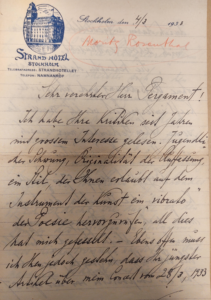
Dear Mr. Pergament!
I have been reading your critiques with great interest for years. Youthful élan, originality of conception, a style that allows you to bring forth a vibrato of poetry on the instrument of art, all this has captivated me. However, I must confess to you just as openly that your most recent article about my concert of the 28.3.1933 [sic] has severely disappointed me with its false doctrines!
You submit that Beethoven must be interpreted without verve and power because his lofty thoughts must be allowed to speak for themselves. We know the composer’s intentions regarding Op. 57 in F minor through his biographer and then young friend Schindler. When Schindler asked him what was on his mind when composing Op. 57, Beethoven answered: “Read Shakespeare’s ‘Tempest’!”
If, indeed, the composer thought of the stormy sea in the outer movements and of the calm sea in the Andante, how can the performer deliver a flaccid, quiet drawing, where Beethoven conceived a glowing painting, how can he translate the thunder of the titan into the indifferent drumming of children? And have you considered what you are doing when, in an influential position, you implant an incorrect view in the minds of thousands of readers?
Or do you believe that enthusiasm can be decreed away for some time? Perhaps the time will come when the minds of performers no longer stir when Beethoven, Chopin and Wagner storm, thunder and fulgurate. Hopefully this time will remain unknown to your faithful
Moriz Rosenthal
Moriz Rosenthal, Letter to Moses Pergament, March 4, 1933. Translated from German by Ronen Shifron1
- Source: The Music and Theater Library (Stockholm), A640, Vol 19-29: Brev, privatpersoner ↩︎